A car heads-up display puts essential driving information closer to your line of sight, helping you check speed without looking down at the instrument cluster. The models in this roundup include plug-in OBD2 units and GPS-based displays with features such as overspeed alerts, RPM readings, and vehicle data.
Use the comparison and buying advice below to find the right balance of compatibility, screen visibility, installation simplicity, and useful information for your vehicle.
Best 10 Car Heads Up Display Picks for 2026
Best GPS Pick

- GPS and BDS positioning with 10Hz refresh
- USB plug-and-play setup without an OBD port
- Large display with automatic brightness
Best For: Drivers wanting a simple GPS speed display
Best Feature-Rich OBD HUD
- Shows speed plus multiple engine and trip readings
- Includes overspeed and vehicle-condition alerts
- Large screen with automatic or manual brightness
Best For: Drivers wanting broad OBD vehicle information
Best Dual-Mode Gauge
- Combines OBD and GPS modes
- Displays speed and extensive vehicle data
- Supports dashboard or windshield installation
Best For: Drivers needing flexible OBD data with GPS fallback
Best Large-Screen OBD HUD

- Large color display with reflection-reducing technology
- Shows speed, temperature, voltage, fuel, and mileage
- Automatic power on and off with the vehicle
Best For: Compatible OBD vehicles needing a large readable screen
Best GPS Car HUD

- GPS-based display works across vehicle models
- Speed, distance, altitude, and direction data
- Overspeed and fatigue-driving reminders
Best For: Drivers wanting a simple, broadly compatible GPS HUD
Best Windshield-Projected HUD
- Projects speed and vehicle data toward windshield
- Shows RPM, temperature, voltage, and mileage
- Automatic power and adjustable brightness
Best For: Compatible gasoline-vehicle owners wanting projected OBD data
Best Multifunction OBD HUD
- 5.5-inch HD display with flexible readouts
- Speed, temperature, voltage, and distance data
- Basic failure detection and alarm functions
Best For: Supported OBD vehicles needing monitoring and diagnostic information
Best with Extra Features

- 10 Hz GPS+BDS positioning
- USB plug-and-play setup
- Adjustable brightness and overspeed alert
Best For: Drivers wanting a simple, compact GPS speed display
Best Windshield Projection

- Projects speed onto the windshield
- Shows RPM, temperature, voltage, and trip data
- Four alarm functions with auto brightness
Best For: Compatible gasoline cars needing projected multi-data monitoring
Best Large Display

- Large 5.5-inch HD projected display
- Shows speed and multiple vehicle readings
- Includes alerts and diagnostic functions
Best For: Drivers wanting a large, multi-function OBD2 HUD
Best GPS Pick – K1 Car HUD Speedometer
This compact car heads up display uses GPS and BDS positioning to project speed into your line of sight. Its USB plug-and-play setup, large numerals, and automatic brightness adjustment make it a practical choice for drivers who want straightforward speed information without an OBD connection.
Best For: Drivers seeking an easy-to-install, GPS-based speed display for vehicles with a USB port.
Pros:
- Uses dual-mode GPS and BDS technology with a 10Hz refresh rate and support for up to 32 satellites.
- Large, anti-reflective display shows speed in MPH by default and is designed for quick reading.
- USB-powered and compatible with most cars, trucks, and motorcycles equipped with a USB port.
- Automatically adjusts brightness for daytime and nighttime driving.
Cons:
- GPS speed can vary by approximately 0.6–1.8 MPH.
- Signal performance may be affected in tunnels, underground garages, heavy rain, fog, or vehicles with metallic windshield film.
This is a focused speedometer rather than a full vehicle-data monitor. It is a strong fit when simple installation and clear GPS speed projection matter more than OBD-based readings.
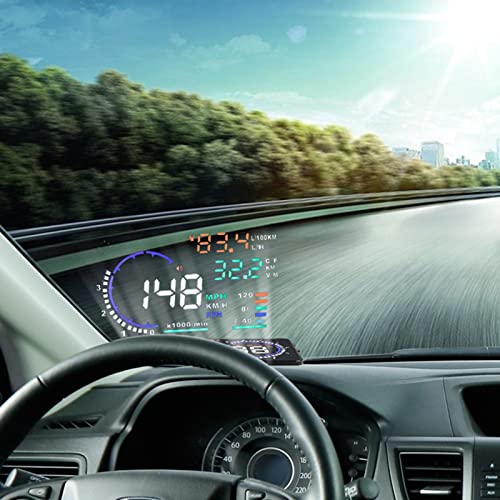
Best Feature-Rich OBD HUD – 5.5-Inch Multi-Color Display
This car heads up display connects through an OBDII or EUOBD interface and projects a broad set of vehicle readings onto a 5.5-inch windshield display. It suits drivers who want more than speed, including alerts for overspeeding, high water temperature, low voltage, and fatigue.
Best For: OBD-compatible drivers who want vehicle data and configurable driving alerts in a large color display.
Pros:
- Displays speed, engine speed, water temperature, battery voltage, fuel consumption, mileage, and fault codes.
- 5.5-inch high-definition screen uses nano-technology to reduce unwanted reflections.
- Offers manual and automatic brightness adjustment.
- Includes overspeed, fatigue-driving, high-temperature, low-voltage, and shift reminders.
Cons:
- Requires a compatible OBDII or EUOBD vehicle.
- Provides less installation flexibility than USB-powered or GPS-only HUDs.
For compatible vehicles, this model provides substantially more information than a basic speed projector. Confirm your vehicle supports OBDII or EUOBD before choosing it.
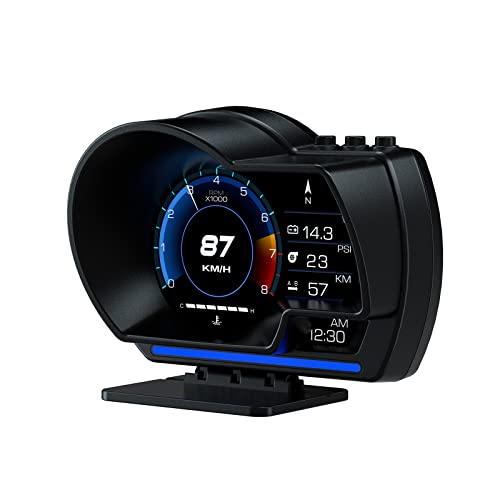
Best Dual-Mode Gauge – P6 OBD2 GPS HUD
The P6 combines OBD and GPS modes in a car heads up display designed to show speed and additional vehicle data at a glance. Its adjustable installation options, ambient-light brightness control, and red overspeed indication make it a versatile option for drivers who want a more informative gauge.
Best For: Drivers who want OBD-based vehicle data with GPS fallback and flexible dashboard or windshield mounting.
Pros:
- Dual OBD and GPS operation can provide speed information even when a vehicle does not support OBD2.
- Offers multiple interfaces and can read more than 100 kinds of vehicle data through the OBD system.
- Displays information such as speed, voltage, fuel consumption, RPM, and water temperature.
- Includes adjustable mounting options and automatic brightness adjustment.
Cons:
- OBD features depend on vehicle compatibility; unsupported vehicles use GPS functionality only.
- The unit is larger and heavier than compact USB-powered HUDs.
The P6 is a good middle ground between a simple speed display and a full vehicle monitor. Its dual-mode design adds flexibility, while the included bracket and tape support different mounting preferences.
Best Large-Screen OBD HUD – 5.5-Inch Windshield Projector
This 5.5-inch car heads up display is designed for OBDII and EUOBD vehicles, with a large color screen and automatic or manual brightness control. It displays core driving and vehicle information while powering on and off with the vehicle, making it a convenient option for compatible cars.
Best For: OBDII or EUOBD vehicle owners who prefer a large, readable screen with automatic startup and shutdown.
Pros:
- Large 5.5-inch color display uses nanometer technology to help prevent reflections.
- Shows speed, water temperature, battery voltage, fuel consumption, and mileage.
- Supports kilometer and mile units and provides multiple vehicle alerts.
- Automatically powers on when the vehicle starts and off when it shuts down.
Cons:
- Compatible only with vehicles using OBDII or EUOBD systems.
- The manufacturer recommends professional installation.
This model emphasizes screen size and hands-free convenience rather than GPS flexibility. It is worth considering when your vehicle is compatible and you want a broad, easy-to-read display with automatic power behavior.
Best GPS Car HUD – G10 Digital Speedometer
The G10 is a practical car heads up display for drivers who want speed, navigation-related data, and reminders without relying on vehicle compatibility. Its 5.5-inch screen uses GPS data, while automatic brightness adjustment helps keep the display readable in changing light.
Best For: Drivers seeking a plug-and-play GPS display with speed alerts and fatigue reminders for almost any vehicle.
Pros:
- Works across vehicle models through GPS rather than an OBD connection.
- Displays speed, driving time, distance, altitude, direction, and location data.
- Includes three-stage overspeed alerts and an eight-hour fatigue-driving reminder.
- Automatic brightness adjustment and included suction cup holder simplify everyday use.
Cons:
- Requires a 5V USB connection or compatible car charger.
- GPS-based information may not provide the same vehicle-data range as an OBD2 display.
Choose this model if broad vehicle compatibility and safety reminders matter more than reading engine data. Its straightforward USB setup and GPS functions make it a flexible option for many cars.
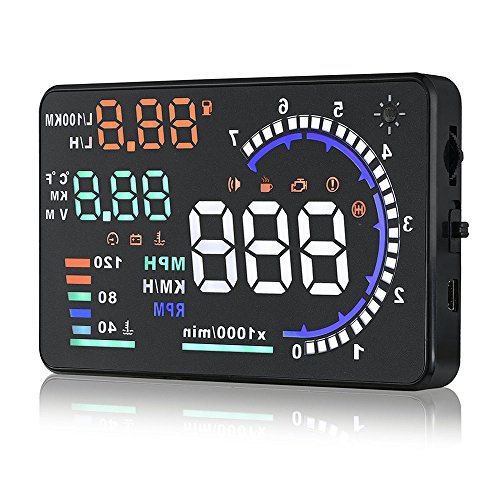
Best Windshield-Projected HUD – A8 OBD2 Car Display
This A8 is a car heads up display designed for compatible OBD II and EUOBD gasoline vehicles. It projects speed and other vehicle metrics toward the windshield, with automatic or manual brightness control for day and night driving.
Best For: Owners of compatible gasoline vehicles who want a windshield-projected display with engine and driving data.
Pros:
- Displays speed, RPM, water temperature, voltage, and single mileage.
- 5.5-inch display uses anti-ghosting reflective film for clearer projection.
- Plug-and-play setup with automatic ignition-linked power on and off.
- Includes an overspeed warning and adjustable brightness.
Cons:
- Not compatible with Dodge, Jeep, Mazda, Suzuki, French or Italian vehicles, and select Hyundai/Kia models.
- Compatibility is limited to OBD II/EUOBD gasoline vehicles.
This model is a strong fit when your vehicle is confirmed compatible and you prefer projected, real-time engine information. Check compatibility before ordering, especially if you drive one of the listed unsupported brands or models.
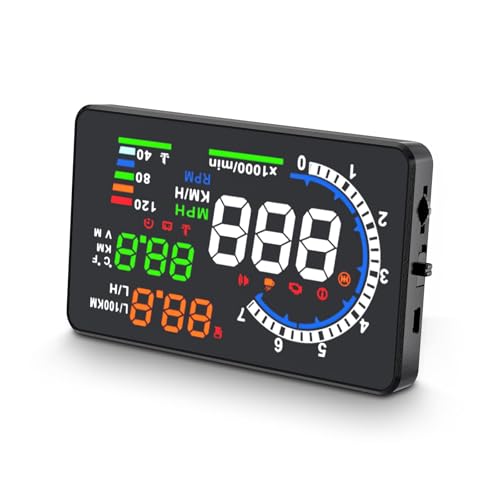
Best Multifunction OBD HUD – wiiyii A8 OBD HUD
The wiiyii A8 is a car heads up display for OBDII and EOBD vehicles that combines a large HD screen with several driving and diagnostic readouts. It can show speed, water temperature, voltage, distance, and alarm prompts while also accessing selected trip-computer information.
Best For: OBDII/EOBD drivers who want a large display with vehicle monitoring and basic diagnostic functions.
Pros:
- Large 5.5-inch, 800×480 display provides clear information switching.
- Shows speed, water temperature, voltage, driving distance, and alarm prompts.
- Supports kilometer and mile switching for flexible use.
- Can read failure information and support failure alarms and clearing through trip-computer data.
Cons:
- Only supports OBDII and EOBD, not OBD I or JOBD.
- Vehicle compatibility depends on the applicable OBD standard and production year.
Consider the wiiyii A8 if you want more than a basic speed readout and your vehicle uses a supported OBD standard. Its diagnostic-oriented functions add utility, but compatibility should be verified before purchase.
Best with Extra Features – Compact K4 Car HUD
If you want a straightforward car heads up display focused on speed, the K4 offers GPS and BDS positioning with a 10 Hz refresh rate. Its USB plug-and-play setup, switchable units, adjustable brightness, and speed calibration make it a practical choice for everyday driving.
Best For: Drivers who want a compact, GPS-based speed display with simple installation.
Pros:
- Dual-mode GPS+BDS reception can track up to 32 satellite signals with a 10 Hz refresh rate.
- USB-powered plug-and-play installation requires no complex setup.
- Offers MPH/KM/H switching, speed calibration, adjustable brightness, and overspeed alerts.
- Large, anti-reflective display is designed for easier daytime and nighttime viewing.
Cons:
- GPS performance may be affected in tunnels, underground garages, heavy rain or fog, and vehicles with metallic windshield film.
- It primarily provides GPS-based speed information rather than the broader vehicle data of an OBD2 display.
The K4 is a sensible pick when speed visibility and easy installation matter most. Its GPS-based design also makes it less dependent on vehicle-specific OBD2 compatibility.
Best Windshield Projection – MAIMEIMI OBD2 HUD
The MAIMEIMI is a car heads up display that projects key readings onto the windshield, helping you view information without looking down at the dashboard. Its OBD2 connection provides speed and additional vehicle data, but compatibility should be checked carefully before purchase.
Best For: Owners of compatible gasoline cars made from 2008 onward who want projected speed and vehicle monitoring.
Pros:
- Projects large-font speed information directly onto the windshield.
- Displays speed, RPM, trip data, water temperature, voltage, and fuel-related readings.
- Includes overspeed, fatigue-driving, speed, and engine-failure alarms.
- Automatic brightness adjustment helps maintain visibility in changing light.
Cons:
- Compatibility is limited to vehicles supporting OBDII or EOBD protocols.
- The notes list numerous exclusions, including many hybrid, diesel, pickup, RV, and specified brand or model applications.
- Installation is easy, but speed may require manual fine-tuning.
This model is more informative than a basic GPS speedometer, especially if you want engine-related readings on the windshield. Its extensive compatibility restrictions make vehicle verification an essential buying step.
Best Large Display – 5.5-Inch OBD2 Car HUD
For shoppers who prefer a larger viewing area, this 5.5-inch car heads up display combines windshield projection with OBD2 vehicle data. It can show speed, RPM, water temperature, voltage, and fuel consumption, while also offering diagnostic functions and automatic brightness adjustment.
Best For: Drivers who want a large projected display with monitoring and basic diagnostic features.
Pros:
- The 5.5-inch HD screen is designed for clear, real-time windshield viewing.
- Displays GPS speed in MPH/KMH along with RPM, water temperature, voltage, and fuel consumption.
- Provides speeding and voltage alerts plus failure detection and failure-code clearing.
- Plug-and-play OBD2/EOBD setup is designed for a wide range of sedans, SUVs, and trucks.
Cons:
- OBD2/EOBD compatibility still needs to be confirmed for the specific vehicle.
- The larger display may be less compact than a basic speed-only HUD.
- Its diagnostic functions depend on the data available through the vehicle’s trip computer.
This is the most feature-rich option of the three for drivers who want more than speed. Choose it when a large display and vehicle-status information outweigh the simplicity of a standalone GPS HUD.
How We Picked the Best Car Heads Up Display
We focused on displays that provide clear, glanceable information without creating unnecessary dashboard clutter. The selection includes OBD2 and EUOBD models for vehicles that support compatible diagnostic ports, along with GPS-based options that can work independently of vehicle data systems. We also considered screen size, readable layouts, speed-unit support, installation requirements, alert functions, and the usefulness of additional readings.
A good Car Heads Up Display should be easy to set up, remain visible in changing light, and show accurate information without forcing the driver to interpret a crowded screen. Features such as automatic brightness adjustment, overspeed alarms, and multiple display modes can improve everyday usability.
Quick Comparison
| Type | Best For | Main Advantage | Watch For |
|---|---|---|---|
| GPS HUD | Broad vehicle compatibility | Works without OBD2 data access | May have a slight startup delay and fewer vehicle readings |
| OBD2 HUD | Vehicles with a compatible diagnostic port | Fast access to speed and engine data | Compatibility varies by vehicle and port standard |
| Multifunction HUD | Drivers wanting extra gauges | Can show RPM, temperature, fuel use, and alerts | More information can make the display busier |
Key Buying Factors for a Car Heads Up Display
Compatibility and Installation
Check whether the unit uses GPS, OBD2, or EUOBD before buying. OBD2 models usually install by plugging into the vehicle’s diagnostic port, but some cars may not provide every supported reading. GPS models generally need only dashboard placement and a clear view of the sky, though the cable and receiver still need sensible routing.
Visibility and Screen Layout
Look for a screen large enough to read quickly and a projector or reflective film designed for your windshield. Adjustable brightness matters for nighttime comfort, while color options and simple layouts can improve readability in daylight. A display should complement your driving view rather than compete with it.
Information and Alerts
Basic speed display is sufficient for many drivers. If you want more functionality, prioritize practical features such as overspeed warnings, RPM, coolant temperature, voltage, or fuel-consumption data. Avoid paying extra for readings you will not use, especially if they make the interface harder to scan.
Units and Accuracy
Make sure the display supports the speed unit used in your region, such as MPH or KM/H. GPS speed may differ slightly from the vehicle’s speedometer, while OBD2 readings depend on the car’s sensors and data systems. A calibration option is useful when available.
Who Should Buy Which Car Heads Up Display?
Choose a GPS model if you want the simplest compatibility across different vehicles or do not want to rely on an OBD2 connection. Choose an OBD2 model if your car has a compatible port and you want quicker access to vehicle information. Choose a larger-screen model if visibility is your top priority, particularly for daytime driving. Choose a multifunction unit if you regularly monitor engine readings and are comfortable with a busier display.
Whichever model you choose, mount it securely, keep cables away from pedals and controls, and confirm that the projected information does not obstruct your view. A well-positioned Car Heads Up Display should make essential data easier—not more distracting—to check.