A car head-up display can make everyday driving easier by putting speed, direction, mileage, and alerts closer to your line of sight. The best models reduce the need to glance down at the instrument cluster without adding a complicated installation.
Our selection includes compact GPS projectors, OBD2-compatible displays, large-screen units, and smart HUDs with wireless CarPlay or Android connectivity. Use the guide below to choose the right balance of readability, compatibility, and useful driving information.
Best 10 Car Head Up Displays for Daily Driving Picks for 2026
Best GPS Accuracy

- 10Hz GPS + BDS positioning
- Large, anti-reflective speed display
- USB-powered with auto brightness
Best For: Drivers wanting a clear GPS speed display without OBD installation
Best Simple Safety Alerts

- Minimal speed-focused projection
- Overspeed and fatigue alerts
- Auto brightness with USB setup
Best For: Drivers who prefer essential speed data and reminder alerts
Best Connected Upgrade

- Wireless Apple CarPlay and Android Auto
- HD anti-reflection display
- Bluetooth audio and hands-free calls
Best For: Drivers wanting navigation and smartphone features without replacing the factory screen
Best All-Vehicle Simplicity
- GPS-based compatibility across vehicle models
- Speed, direction, and safety alerts
- USB plug-and-play with auto brightness
Best For: Drivers wanting a basic GPS HUD without vehicle-specific connections
GPS Precision Pick

- GPS+BDS reception with a 10 Hz refresh rate
- USB plug-and-play power and MPH/KM/H switching
- Adjustable brightness, calibration, and overspeed alert
Best For: Simple GPS speed tracking during daily commutes
Vehicle Data Monitor
- Shows speed plus multiple engine and trip measurements
- Provides several configurable driving alerts
- Automatic power control and adjustable display brightness
Best For: OBD-compatible vehicles needing broader dashboard information
Multifunction Display Pick

- GPS and Beidou dual-mode satellite positioning
- More than ten configurable display combinations
- 5.5-inch screen, USB setup, and rotating bracket
Best For: Customizable trip and navigation-style data display
Best Multifunction Pick
5.5-Inch OBD2 Vehicle Data HUD

- Large 5.5-inch HD display
- Shows multiple vehicle metrics
- Includes OBD2 alerts and diagnostics
Best For: Drivers seeking speed, engine data, and diagnostics
Best No-OBD Pick

- USB plug-and-play installation
- Large MPH display with auto brightness
- GPS and BDS positioning
Best For: Drivers wanting a speed reference without OBD wiring
Best GPS Accuracy – K1 10Hz Car HUD
For drivers comparing car head up displays for daily driving, the K1 emphasizes fast GPS updates, a large speed readout, and simple USB installation. Its 10Hz GPS + BDS positioning and automatic brightness adjustment make it a practical speed-focused choice for varied driving conditions.
Best For: Drivers who want a large, GPS-based speed display without using an OBD port.
Pros:
- 10Hz GPS + BDS positioning connects with up to 32 satellites.
- Large MPH display with anti-reflective metal shading.
- Automatic brightness adjustment for day and night driving.
- USB-powered and compatible with vehicles equipped with a USB port.
Cons:
- GPS speed can vary by approximately 0.6–1.8 MPH.
- Satellite reception may be affected by tunnels, garages, weather, or metallic windshield film.
The K1 is a straightforward option when speed visibility and GPS refresh rate matter more than navigation or smartphone features. It is especially convenient for vehicles without a compatible OBD port.
Best Simple Safety Alerts – M1 White Windshield HUD
The M1 is a minimalist choice among car head up displays for daily driving, projecting speed onto the windshield while keeping the information limited to essential driving data. It also adds overspeed and fatigue-driving alerts for drivers who prefer basic reminders rather than a feature-heavy screen.
Best For: Drivers who want a simple speedometer with direction, overspeed, and fatigue reminders.
Pros:
- Displays speed, GPS compass direction, and selectable MPH or KM/H units.
- Includes overspeed and continuous-driving fatigue alerts.
- Automatic and manual brightness adjustment.
- Plug-and-play USB installation with included reflective film and anti-slip mat.
Cons:
- Satellite acquisition can be slower in garages, dense buildings, or under overpasses.
- Metallic windshield film and nearby GPS devices may interfere with reception.
The M1 keeps the projected view uncluttered, which may suit drivers who want only speed and a few safety prompts. Its GPS-dependent operation means it works best after satellite lock is established in an open area.
Best Connected Upgrade – VIVIHUD V3-SE Wireless HUD
For drivers seeking more than a speed readout, the V3-SE combines a head-up display with wireless Apple CarPlay and Android Auto. It brings navigation, music, calls, messages, and voice assistants to a separate HD screen without replacing the vehicle’s original display.
Best For: Drivers who want smartphone connectivity, navigation, and hands-free media in older or non-CarPlay vehicles.
Pros:
- Supports wireless Apple CarPlay and Android Auto.
- Offers screen mirroring, Bluetooth audio, and hands-free calling.
- HD anti-reflection display with adjustable viewing angle.
- Portable installation works with cars, SUVs, pickups, vans, and RVs.
Cons:
- Requires a compatible iPhone or Android phone for its connected features.
- Provides more setup and feature complexity than a basic GPS speedometer.
The V3-SE is the most capable option here for connected daily driving. Choose it when navigation and smartphone functions are priorities; choose a simpler GPS HUD if you only need speed projected ahead.
Best All-Vehicle Simplicity – M1 GPS Speedometer HUD
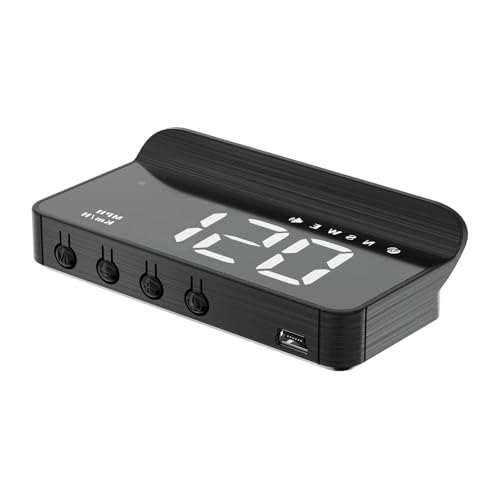
This M1 windshield projector is a practical pick among car head up displays for daily driving when broad vehicle compatibility and simple operation are the main goals. It uses GPS rather than the vehicle engine, displays speed and direction, and adds overspeed and fatigue reminders.
Best For: Drivers who want a plug-and-play GPS speedometer for cars without relying on vehicle-specific connections.
Pros:
- GPS-based operation is designed to work across vehicle models.
- Shows speed, driving direction, and compass information.
- Includes overspeed and fatigue-driving alarms.
- Automatic brightness adjustment with MPH and KM/H settings.
Cons:
- Speed appears only after the unit acquires satellite signal.
- Garages, dense buildings, overpasses, and metallic film can slow satellite acquisition.
- Requires a 5V power supply; higher voltage is prohibited.
The M1 favors an uncluttered display and wide compatibility over advanced connectivity. It is a sensible daily-driving solution if you want basic speed information and alerts, provided you can supply the required 5V USB power.
GPS Precision Pick – K4 Car HUD
For drivers comparing car head up displays for daily driving, the K4 focuses on straightforward GPS speed tracking, easy USB installation, and a readable speed display. Its dual GPS+BDS reception, 10 Hz refresh rate, adjustable brightness, and speed calibration make it a practical choice for routine commutes.
Best For: Drivers who want a simple plug-and-play GPS speedometer with customizable alerts and brightness.
Pros:
- Dual GPS+BDS positioning can receive up to 32 satellite signals.
- USB plug-and-play setup with MPH/KM/H switching.
- Adjustable brightness, speed calibration, and overspeed alerts.
- Large, anti-reflective speed display is designed for easy viewing.
Cons:
- GPS performance may be affected in tunnels, garages, heavy rain, fog, or behind metallic windshield film.
- Displays GPS-based driving information rather than the broader vehicle data offered by OBD models.
The K4 is a focused option when speed visibility matters most. Its compact design and USB power keep installation uncomplicated, while calibration and alert settings add useful flexibility for everyday driving.
Vehicle Data Monitor – 5.5-Inch OBD HUD
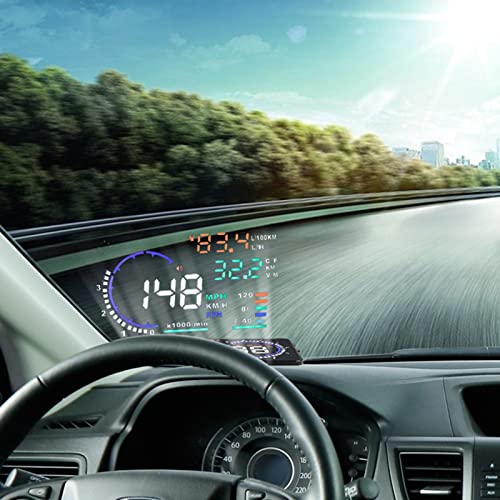
Among car head up displays for daily driving, this 5.5-inch OBDII/EUOBD model stands out for showing more than speed. It can project selected vehicle information, including engine speed, water temperature, battery voltage, fuel-use data, and fault codes, provided the vehicle is compatible with the required interface.
Best For: OBDII- or EUOBD-compatible vehicles whose drivers want expanded vehicle information and warning reminders.
Pros:
- Displays speed, engine speed, water temperature, battery voltage, fuel consumption, mileage, and fault codes.
- Manual brightness adjustment plus automatic brightness optimization.
- Overspeed, fatigue-driving, high-temperature, low-voltage, and shift reminders.
- Automatic power-on and power-off follows the vehicle’s operating state.
Cons:
- Compatibility is limited to vehicles with OBD II or EUOBD systems.
- The supplied notes do not specify the exact vehicle models or years supported.
- Requires an OBDII/EUOBD connection rather than simple USB-only power.
This model is more feature-oriented than a basic GPS speed display, making it useful for drivers who want a quick view of vehicle metrics. Confirm your car’s OBD compatibility before choosing it.
Multifunction Display Pick – G12 GPS HUD
The G12 is a versatile choice for shoppers seeking car head up displays for daily driving with more trip information than a basic speedometer. Its GPS and Beidou dual-mode chip supports satellite searching, while the 5.5-inch borderless screen offers multiple display combinations for speed, time, mileage, direction, and other driving details.
Best For: Drivers who want a larger, configurable GPS display with trip metrics and flexible mounting.
Pros:
- GPS and Beidou dual-mode positioning supports faster satellite searching.
- Offers more than ten display combinations for customized viewing.
- Tracks speed, time, driving time, mileage, direction, coordinates, and acceleration data.
- USB plug-and-play setup with a 360-degree rotating bracket and one-year warranty.
Cons:
- The 5.5-inch body is larger than compact speed-only HUD units.
- As a GPS-based display, its information depends on satellite reception.
- The many display options may require setup to find the most useful layout.
The G12 suits drivers who want a broader trip-information display without an OBD installation. Its large screen and rotating bracket provide placement flexibility, while the configurable interfaces let you prioritize the data you use most.
Best Compact GPS Pick – Day & Night Digital Speedometer HUD
For drivers comparing car head up displays for daily driving, this compact GPS-based model keeps speed information near your line of sight without requiring an OBD connection. Its USB-powered setup, automatic brightness adjustment, and included projection accessories make it a straightforward choice for everyday use in sedans, SUVs, and trucks.
Best For: Drivers who want a small, plug-and-play windshield speed display with automatic day-and-night brightness.
Pros:
- Uses GPS and BeiDou positioning for real-time speed information.
- Automatically adjusts brightness, with brighter daytime display and softer nighttime illumination.
- Compact 3.63-by-2.00-inch design connects through a 5V USB port.
- Includes projection film, scraper, adhesive, cable, and manual.
Cons:
- Primarily focuses on displaying speed rather than broader vehicle data.
- GPS-based readings depend on satellite positioning conditions.
- Warranty coverage is listed as three months.
This HUD is a practical fit when simple speed visibility matters more than diagnostics or extensive vehicle metrics. Its small footprint and automatic dimming help it blend into a daily-driving setup.
Best Multifunction Pick – 5.5-Inch OBD2 Vehicle Data HUD
Among car head up displays for daily driving, this 5.5-inch OBD2 model stands out for showing more than speed. It can present engine RPM, water temperature, voltage, and fuel consumption while also offering warning prompts and diagnostic functions, provided your vehicle uses a compatible OBD2 or EOBD protocol.
Best For: Drivers who want a large display with vehicle information, alerts, and basic OBD2 diagnostic capabilities.
Pros:
- Large 5.5-inch HD display with automatic brightness adjustment.
- Shows GPS speed, RPM, water temperature, voltage, and fuel consumption.
- Provides speeding and voltage alerts for added monitoring.
- Supports failure detection, failure alarms, and failure-code clearing.
Cons:
- Requires a compatible OBD2 or EOBD vehicle, generally vehicles after 2003.
- More feature-heavy than a basic speed-only HUD.
- OBD2 data availability can vary by vehicle.
This is the strongest option here for drivers who want a dashboard-style information center rather than only a projected speed reading. Confirm your vehicle’s OBD2 compatibility before buying.
Best No-OBD Pick – GPS Co-Pilot Speed HUD
For car head up displays for daily driving that avoid vehicle wiring and OBD compatibility concerns, this GPS HUD uses a standard 5V USB power source. It displays large MPH digits, automatically adjusts brightness, and is designed for quick speed checks during commutes, highway trips, and other open-area driving.
Best For: Drivers who want a large MPH speed reference without connecting to the vehicle’s OBD port.
Pros:
- GPS and BDS dual-mode positioning with a 10Hz refresh rate.
- USB plug-and-play setup requires no OBD connection or wiring modification.
- Automatic brightness adjustment and an anti-reflective shade support day-and-night viewing.
- Works with a variety of USB-equipped vehicles and recreational vehicles.
Cons:
- GPS readings may vary by approximately 0.6–1.8 MPH.
- Satellite reception can be limited in tunnels, garages, indoors, or behind metallic windshield film.
- First satellite lock typically takes 10–30 seconds in an open area.
This model is a sensible choice for a speed-only display when easy installation is the priority. Its two-year manufacturer warranty is also longer than the coverage listed for the compact GPS alternative.
How We Picked the Best Car Head Up Displays for Daily Driving
We focused on features that matter during regular commuting, errands, and road trips: clear daytime and nighttime visibility, dependable speed readings, simple setup, useful warning functions, and compatibility with a wide range of vehicles. We also considered whether a display uses GPS, OBD2, USB, or smartphone connectivity, since each option affects installation and the information available.
Because a HUD should support—not distract from—driving, priority went to designs with readable layouts, adjustable brightness where available, and practical controls. Overspeed alerts, direction displays, mileage data, and CarPlay or Android integration can be valuable, but only when they remain easy to understand at a glance.
Quick Comparison
| Type | Best For | Main Advantage | Potential Trade-Off |
|---|---|---|---|
| GPS HUD | Most vehicles | Simple installation and broad compatibility | May show fewer vehicle-specific details |
| OBD2 HUD | Cars with a compatible diagnostic port | Can display vehicle data such as RPM or engine information | Compatibility varies by vehicle |
| Large-screen HUD | Drivers who prioritize readability | More visible numbers and warnings | Uses more dashboard or windshield space |
| Smart CarPlay or Android HUD | Connected driving | Navigation and phone features in one display | More setup and connectivity requirements |
Key Buying Factors for Car Head-Up Displays for Daily Driving
Display Clarity and Placement
Choose a screen that remains legible in sunlight and does not create distracting reflections at night. A compact display may suit a small dashboard, while a 5.5-inch model can be easier to read from a normal driving position. Confirm that the projected image or screen can be positioned without blocking your view.
GPS Versus OBD2 Connectivity
GPS models are generally the easiest choice for older cars, newer cars, and vehicles without a convenient OBD2 connection. OBD2 units may provide richer vehicle information, but they depend on port access and vehicle compatibility. USB-powered designs are usually straightforward, though cable routing can affect the finished installation.
Useful Information and Alerts
For daily driving, speed, direction, mileage, and overspeed warnings are often enough. If you want navigation prompts, calls, or media controls, consider a connected CarPlay or Android model. Avoid paying for features you will not use, especially if a simpler display is clearer.
Units, Brightness, and Reliability
Check whether the display supports MPH, KM/H, automatic brightness, and day/night adjustment. Also review the included power cable, windshield film if required, mounting method, and return policy before buying.
Who Should Buy Which Car Head Up Displays for Daily Driving?
- Choose a GPS HUD if you want the easiest universal installation and primarily need speed and direction.
- Choose an OBD2 model if your vehicle is confirmed compatible and you want additional car data.
- Choose a large-screen display if small numbers are difficult to read or you drive frequently in unfamiliar areas.
- Choose a CarPlay or Android HUD if connected navigation and smartphone functionality are central to your routine.
- Choose a compact, basic unit if you want an affordable speed reminder with minimal dashboard clutter.
The best choice among these Car Head Up Displays for Daily Driving is the one that gives you the information you need quickly, installs securely, and remains readable in the lighting conditions you encounter most.