Adding a head-up display can give an older car a modern, easier-to-read speed display without replacing the factory dashboard. The best models project essential information near your line of sight, helping reduce glances toward the instrument cluster.
This roundup compares 10 options, including plug-in OBD2 displays and wireless GPS units. Use the guide below to match the right connection type, screen, features, and installation method to your vehicle and driving habits.
Best 10 Car Head Up Displays for Older Cars Picks for 2026
Best Plug-and-Play Pick

- No OBD port required
- Large, auto-brightness MPH display
- GPS/BDS positioning with 10Hz refresh
Best For: Older cars with a USB port and drivers wanting simple GPS speed projection
Best OBD Simplicity

- Plug-and-play OBD II/EUOBD connection
- Anti-glare reflective screen
- Automatic ignition power and mileage tracking
Best For: Compatible older cars needing a large, basic OBD-connected display
Best Data-Rich Option
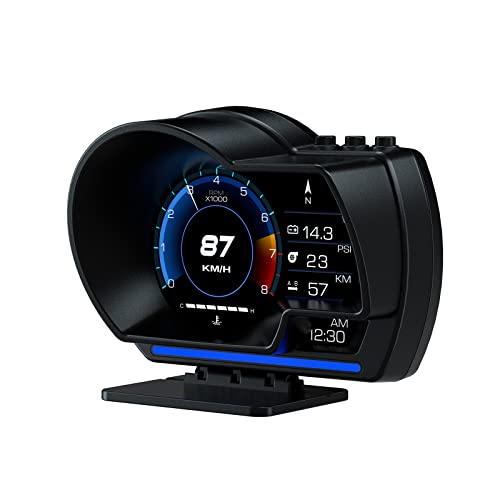
- OBD2 plus GPS dual mode
- Displays extensive vehicle data
- Dashboard or windshield mounting
Best For: Drivers seeking speed, vehicle metrics, and overspeed alerts in one display
Best Solar-Powered Choice

- Solar and USB charging
- Large LCD with multiple readouts
- Overspeed and fatigue reminders
Best For: Older cars where a rechargeable, solar-assisted GPS display is preferred
Plug-and-Play OBD Value

- OBD II/EUOBD plug-and-play connection
- 3-inch high-definition display
- Speed, temperature, voltage, and alarm data
Best For: Compatible older cars needing a simple OBD information display
GPS Simplicity Pick

- USB plug-and-play installation
- 5.5-inch borderless display
- GPS speed, trip, time, and direction data
Best For: Drivers wanting easy installation without relying on an OBD connection
Windshield Projection Choice

- Projects speed onto the windshield
- Tracks RPM, temperature, voltage, and trips
- Automatic brightness and four alarm functions
Best For: Compatible post-2008 gasoline cars needing projected, multi-data monitoring
Best GPS Pick

- USB-powered GPS installation
- Large MPH/KM/H speed display
- Brightness control and overspeed alert
Best For: Older drivers wanting a simple speed display
Best OBD Value
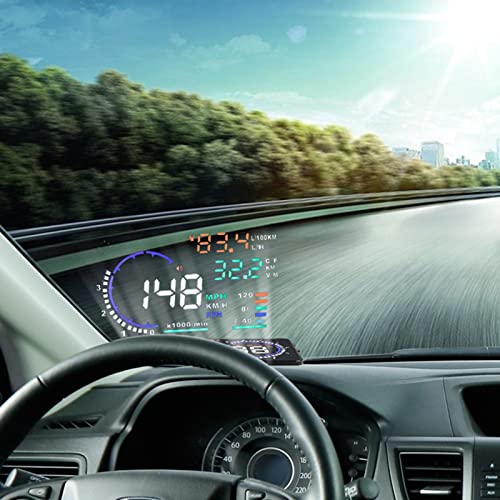
- 5.5-inch adjustable display
- Shows speed, RPM, temperature, and voltage
- Multiple driving and vehicle alerts
Best For: Compatible cars needing broader vehicle information
Best Feature Set

- 5.5-inch HD display with auto brightness
- Shows speed and multiple engine readings
- Includes alerts and failure-code functions
Best For: Compatible cars needing a large multifunction display
Best Plug-and-Play Pick – USB GPS HUD for Older Cars
If you need car head up displays for older cars without an OBD port, this USB-powered GPS model is a practical option. It projects speed in a large font, uses automatic brightness adjustment, and works with vehicles equipped with a 5V USB port.
Best For: Drivers who want a simple, readable speed display for an older car without connecting to the vehicle’s diagnostic system.
Pros:
- USB plug-and-play design requires no OBD port.
- GPS and BDS positioning with a 10Hz refresh rate and support for up to 32 satellites.
- Large MPH display, anti-reflective shading, and automatic brightness adjustment.
- Compatible with most cars, trucks, and motorcycles that have a USB port.
Cons:
- GPS speed can vary by approximately 0.6–1.8 MPH.
- Signal may be affected in tunnels, underground garages, heavy rain, fog, or vehicles with metallic windshield film.
Its USB power and large display make it especially suitable for older vehicles lacking modern built-in projection features. Because it relies on GPS, signal conditions should be considered before purchase.
Best OBD Simplicity – 5.5-Inch Reflective OBD HUD
For older cars with OBD II or EUOBD compatibility, this connected display offers a straightforward installation and a 5.5-inch reflective screen. It adds automatic ignition-linked power control, mileage measurement, and adjustable brightness for daily driving.
Best For: OBD II-equipped vehicles whose drivers want a larger reflective display with basic trip and driving information.
Pros:
- Plug-and-play operation for compatible OBD II or EUOBD vehicles.
- 5.5-inch screen with a nano anti-reflection coating.
- Automatically powers on and off with the vehicle.
- Includes driving mileage measurement and automatic or manual brightness control.
Cons:
- Requires a compatible OBD II or EUOBD system.
- Its feature set is centered on display and mileage functions rather than the broader data monitoring offered by some models.
This is a sensible choice when an older car has a working OBD II port and you prefer ignition-linked operation. Confirm vehicle compatibility before ordering, since it is not a universal USB-only unit.
Best Data-Rich Option – wiiyii P6 OBD2/GPS HUD
The wiiyii P6 is one of the more information-focused car head up displays for older cars, combining OBD2 and GPS modes. It can show speed alongside vehicle data such as voltage, fuel consumption, RPM, and water temperature, while offering dashboard or windshield mounting.
Best For: Drivers with a compatible older car who want more than speed, including vehicle data and overspeed alerts.
Pros:
- Dual OBD2 and GPS operation; GPS mode remains available if the vehicle lacks the required OBD2 protocol.
- Supports multiple interfaces and can read more than 100 types of vehicle data through OBD.
- Displays speed, voltage, fuel consumption, RPM, and water temperature.
- Offers automatic brightness adjustment, overspeed color alerts, and two mounting methods.
Cons:
- OBD features depend on vehicle compatibility; unsupported vehicles use GPS functionality only.
- The larger unit and included cable may require more installation space than a compact USB display.
Choose the P6 if you want a multifunction gauge rather than a speed-only HUD. Its dual-mode design improves flexibility, but buyers should verify the car’s OBD2 protocol if they want the full range of data.
Best Solar-Powered Choice – Wireless GPS Speedometer HUD
This wireless GPS speedometer is a flexible option for older cars because it supports both solar and USB charging. Its large LCD can show speed, time, temperature, and altitude, while adjustable overspeed and fatigue-driving reminders add extra information during trips.
Best For: Drivers who prefer a solar-assisted, battery-powered display with multiple readouts and configurable alerts.
Pros:
- Supports solar charging and USB power with a built-in rechargeable battery.
- Large LCD digits are designed for clear daytime and nighttime viewing.
- Displays speed, time, temperature, and altitude through GPS positioning.
- Includes adjustable overspeed alarms and fatigue-driving reminders.
Cons:
- GPS-based readings depend on positioning signal and may not provide vehicle diagnostic data.
- Solar charging performance will depend on available light.
The solar panel and internal battery reduce reliance on a permanent vehicle connection, making this appealing for older cars with limited integration options. It is best suited to buyers who value multiple environmental and trip readouts over OBD information.
Plug-and-Play OBD Value – Dual-Mode Car HUD
For drivers comparing car head up displays for older cars, this model offers a straightforward OBD II/EUOBD connection and a readable 3-inch screen. It displays core vehicle information without requiring a complicated installation.
Best For: Drivers with a compatible OBD II or EUOBD vehicle who want speed, engine, temperature, and voltage information in one compact display.
Pros:
- Plug-and-play design automatically adapts to compatible OBD II/EUOBD cars.
- Displays speed, engine speed, water temperature, battery voltage, and multiple alarms.
- Nanotechnology helps reduce reflections, while automatic power control protects the car battery.
Cons:
- Compatibility depends on the vehicle having an OBD II or EUOBD system.
- The 3-inch display is smaller than some GPS-based alternatives.
This is a practical choice for older compatible cars needing basic real-time data and simple controls. Confirm your vehicle’s diagnostic-system compatibility before buying.
GPS Simplicity Pick – G12 Multifunction HUD
Among car head up displays for older cars, the G12 stands out for its USB plug-and-play setup rather than an OBD connection. Its GPS and Beidou dual-mode positioning supports speed and trip information, making installation quick and broadly accessible.
Best For: Drivers who want a large GPS speed display with flexible placement and more than one interface layout.
Pros:
- USB installation is designed to be plug-and-play and takes about five seconds.
- 5.5-inch borderless screen offers multiple display combinations.
- Tracks speed, time, mileage, direction, coordinates, acceleration, and fatigue reminders.
- 360-degree rotating bracket supports different mounting positions.
Cons:
- GPS-based information may not provide the same vehicle-specific data as an OBD display.
- The supplied notes do not indicate engine temperature, RPM, or battery-voltage monitoring.
The G12 is a convenient option when quick USB installation and a large, adjustable screen matter more than direct engine diagnostics. Its one-year warranty adds useful ownership support.
Windshield Projection Choice – MAIMEIMI OBD2 HUD
For compatible post-2008 gasoline vehicles, this MAIMEIMI model is one of the more direct car head up displays for older cars because it projects key information onto the windshield. Its OBD2 connection provides vehicle data such as speed, RPM, water temperature, and voltage.
Best For: Owners of compatible 2008-or-newer gasoline cars who want windshield projection, multiple vehicle readings, and configurable alerts.
Pros:
- Projects large speed information onto the windshield instead of using only a separate screen.
- Displays speed, RPM, trip, water temperature, voltage, and fuel-consumption modes.
- Includes overspeed, fatigue-driving, speed, and engine-failure alarms.
- Automatic brightness adjusts to changing light conditions.
Cons:
- Compatibility is limited to supported OBDII/EOBD gasoline vehicles made after 2008.
- It does not support OBDI, JOBD, hybrids, diesel vehicles, and several listed makes and models.
- Installation is simple, but speed accuracy may require manual fine-tuning.
This is the most feature-rich option here for drivers whose vehicle meets the compatibility requirements. Check the extensive exclusions carefully, especially if your car is a hybrid, diesel, imported model, or has a modified ECU.
Best GPS Pick – Compact Plug-and-Play HUD
For drivers comparing car head up displays for older cars, this compact GPS-based model offers a simple USB-powered way to view speed without connecting to the vehicle’s diagnostic system. Its large readout, adjustable brightness, speed calibration, and MPH/KM/H switching make it practical for everyday driving.
Best For: Older drivers and owners seeking a simple GPS speed display with easy installation.
Pros:
- USB plug-and-play power avoids complex installation.
- GPS+BDS positioning and a 10 Hz refresh rate support responsive speed readings.
- Large, anti-reflective display includes adjustable brightness and an overspeed alert.
- Manual speed calibration helps match the vehicle’s dashboard reading.
Cons:
- GPS performance may be affected in tunnels, garages, heavy rain, fog, or vehicles with metallic windshield film.
- Displays GPS-derived speed rather than the broader vehicle data available from an OBD-based unit.
This is the most straightforward option for an older car when you primarily want a readable speedometer and do not want to check OBD compatibility. Its GPS dependence is the main trade-off.
Best OBD Value – Multi-Color Vehicle Data HUD
Among car head up displays for older cars, this OBDII/EUOBD model is suited to drivers who want more than speed. It can show engine and vehicle information on a 5.5-inch display, with automatic power control, adjustable brightness, and several warning functions.
Best For: Owners of OBD II or EUOBD-compatible cars who want speed, engine data, and alerts in one display.
Pros:
- Shows speed, RPM, water temperature, battery voltage, fuel consumption, and mileage.
- Provides overspeed, fatigue-driving, high-temperature, low-voltage, and shift reminders.
- Nano-technology display is designed to reduce unwanted reflections.
- Automatically powers on and off with the vehicle.
Cons:
- Requires a compatible OBD II or EUOBD vehicle.
- Its feature-rich display may be more involved than a basic GPS speedometer.
This model makes sense when an older car has the required diagnostic interface and you value vehicle monitoring as much as speed projection. Confirm compatibility before buying.
Best Feature Set – Large-Screen OBD2 HUD
This large-screen option is a strong contender for car head up displays for older cars when the vehicle supports OBD2 or EOBD. It combines a 5.5-inch HD display with GPS speed, engine information, warning prompts, and diagnostic functions in a plug-and-play package.
Best For: Drivers with compatible cars who want a prominent display plus basic diagnostic and maintenance information.
Pros:
- 5.5-inch HD screen and automatic brightness adjustment support daytime and nighttime visibility.
- Displays MPH/KMH speed, RPM, water temperature, voltage, and fuel consumption.
- Offers speeding and voltage alerts along with failure detection and failure-code functions.
- Plug-and-play setup works with OBD2/EOBD vehicles, described as widely used after 2003.
Cons:
- Requires an OBD2 or EOBD-compatible vehicle.
- The larger screen and many functions may be excessive for drivers who only need speed.
Choose this model for the broadest feature set of the three, especially if a large readout and vehicle diagnostics are priorities. Compatibility remains the key consideration for older cars.
How We Picked the Best Car Head Up Displays for Older Cars
We focused on displays that can add useful driving information to older vehicles with minimal installation. The selection includes OBD2/EUOBD models for compatible cars and GPS-based units that work independently of the vehicle’s diagnostic system. We also considered screen readability, power options, speed-unit support, alarms, installation flexibility, and the usefulness of extra data such as mileage, altitude, temperature, or trip information.
Because compatibility varies by vehicle, confirm your car’s diagnostic-port standard and model-year requirements before ordering. GPS displays are generally the safer choice when OBD2 support is uncertain.
Quick Comparison
| Display type | Best for | Main advantage | Potential limitation |
|---|---|---|---|
| OBD2/EUOBD | Compatible cars needing vehicle data | Fast setup and access to car-derived information | May not work with every older vehicle |
| GPS | Broad compatibility | Independent speed measurement | Can take time to acquire a satellite signal |
| Dual-mode | Drivers who want flexibility | Can switch between connection methods | More settings and wiring to manage |
| Large reflective screen | Drivers prioritizing visibility | Easy-to-see projected information | May occupy more windshield or dashboard space |
Key Buying Factors for Car Head-Up Displays for Older Cars
Compatibility and Power
Check whether the unit requires an OBD2 or EUOBD port, a USB connection, or a solar-powered setup. An OBD2 device is convenient when supported, but some older cars may use a different diagnostic standard or provide limited data. GPS models usually connect through USB or a vehicle power socket and are less dependent on the car’s electronics.
Readability and Projection
Choose a screen size and color scheme that remain clear in daylight and at night. A reflective windshield film or included projection panel can improve contrast, while adjustable brightness helps prevent glare after dark. Position the display where it is visible without blocking your view of the road.
Information and Alerts
At minimum, look for accurate MPH/KMH speed display and an adjustable overspeed alarm. Additional functions such as coolant temperature, voltage, mileage, altitude, or driving time are useful only if they are clearly presented and supported by the vehicle or GPS signal.
Installation and Durability
Older-car upgrades should be simple to install and remove. Look for secure mounting, tidy cable routing, a stable power connection, and controls that can be adjusted without excessive distraction.
Who Should Buy Which Car Head Up Displays for Older Cars?
Choose an OBD2 model if your older car is confirmed compatible and you want quick access to vehicle-based information. Choose a GPS display if compatibility is uncertain, you want a portable unit, or you frequently switch vehicles. Choose a larger screen if visibility is your top priority, particularly for night driving or drivers who find small dashboard gauges difficult to read. Choose a dual-mode model if you want a backup connection method and do not mind additional setup options.