Adding one of the best four-channel car amplifiers can give a factory or aftermarket system more headroom, cleaner output, and useful installation flexibility. These models cover compact Class D designs, traditional Class AB amps, and higher-output options for multi-speaker setups.
We compare the key specifications that matter most, including RMS power, impedance compatibility, crossover controls, amplifier class, wiring flexibility, and overall system-matching potential.
Best 10 Four Channel Car Amplifiers Picks for 2026
Balanced Power Pick

- 60W RMS x 4 at 4 ohms
- Bridged 190W RMS x 2 output
- Variable high- and low-pass filters
Best For: Flexible front-and-rear speaker systems
Compact Efficiency Pick

- 65W RMS x 4 at 4 ohms
- Class D, space-efficient design
- Adjustable 40Hz–500Hz filters
Best For: Compact daily-driver and custom installations
High-Output Versatility Pick

- 130W RMS x 4 at 2 ohms
- 260W RMS x 2 bridged
- Compact Class D chassis with extensive controls
Best For: Powerful, tunable systems with limited install space
High-Power Class A/B Pick

- 100W RMS x 4 at 2 ohms
- Adjustable LPF, HPF, and bass boost
- MOSFET supply with protection circuitry
Best For: Tunable Class A/B speaker systems
Compact Flexible Pick

- 4 x 100W RMS at 2 ohms
- High-level and RCA inputs
- Built-in HPF, LPF, and full-range modes
Best For: OEM upgrades and compact vehicle audio builds
Feature-Rich Power Option

- Class A/B four-channel design
- High- and low-pass filters plus bass boost
- 75W x 4 at 2 ohms RMS
Best For: RCA-based systems needing adjustable sound control
High-Output Speaker Driver
- 250W RMS x 4 at 2 ohms
- Full-range Class A/B design
- Four-way protection circuitry
Best For: High-powered full-range speaker systems
Balanced Upgrade
- 40W RMS x 4 at 4 ohms
- Bridgeable for 130W RMS x 2
- Variable high- and low-pass filters
Best For: Balanced front-and-rear speaker upgrades
High-Power Choice

- 4 x 300W RMS at 2 ohms
- High-level inputs for factory radios
- HPF, LPF, and full-range modes
Best For: Demanding high-output custom audio systems
Budget-Friendly Starter

- Four-channel Class A/B design
- Supports 2- to 8-ohm speakers
- Compact chassis with six-year warranty
Best For: Affordable basic speaker upgrades
Balanced Power Pick – Pioneer GM-A6704
Pioneer GM-A6704 1000W Max Class AB Bridgeable 4-Channel Car Amplifier | High-/Low-Pass Filters
Check Price On AmazonFor shoppers comparing four channel car amplifiers, the Pioneer GM-A6704 is a flexible Class A/B option with 60 watts RMS x 4 at 4 ohms and 190 watts RMS x 2 when bridged. Its variable high- and low-pass filters make it suitable for tuning a mixed speaker setup.
Best For: Drivers who want versatile front-and-rear speaker power with the option to add bridged bass output.
Pros:
- Provides 60 watts RMS x 4 at 4 ohms or 190 watts RMS x 2 bridged.
- Includes variable high- and low-pass filters for frequency control.
- Class A/B design is built for balanced performance and efficiency.
Cons:
- Class A/B construction may be less space-efficient than a comparable Class D design.
- The 1,000-watt maximum rating is substantially higher than its listed continuous 4-ohm output.
The GM-A6704 is a sensible choice when tuning flexibility matters more than an especially compact chassis. Its bridged mode also gives a little extra system-building versatility.
Compact Efficiency Pick – Orion CEA400.4D
The Orion CEA400.4D is a compact Class D choice for four channel car amplifiers, delivering 65 watts RMS x 4 at 4 ohms or 100 watts RMS x 4 at 2 ohms. Its adjustable 40Hz–500Hz filters support flexible speaker and frequency configurations.
Best For: Space-limited installations powering door speakers, component sets, or full-range systems.
Pros:
- Compact chassis fits cars, trucks, and SUVs where installation space is limited.
- Offers 65 watts RMS x 4 at 4 ohms and 100 watts RMS x 4 at 2 ohms.
- Class D design helps reduce heat and current draw.
- Built-in protection covers thermal overload, short circuits, and voltage irregularities.
Cons:
- Its 400-watt maximum rating is lower than some larger four-channel alternatives.
- Power output is more modest for systems requiring very high continuous output.
Choose the CEA400.4D when installation space and efficient operation are priorities. It offers practical multi-channel power without requiring a large amplifier footprint.
High-Output Versatility Pick – Recoil DI550.4
The Recoil DI550.4 stands out among four channel car amplifiers with 130 watts RMS x 4 at 2 ohms, 80 watts RMS x 4 at 4 ohms, and 260 watts RMS x 2 when bridged. Gain, LPF, HPF, crossover, and bass EQ controls provide broad tuning flexibility.
Best For: Enthusiasts who need strong multi-channel output in a slim, compact chassis.
Pros:
- Delivers up to 130 watts RMS x 4 at 2 ohms.
- Supports 260 watts RMS x 2 in bridged mode.
- Includes adjustable gain, LPF, HPF, crossover, and bass EQ controls.
- Compact 7.48 x 5.90 x 1.77-inch design with cooling heatsinks.
Cons:
- Its extensive controls may require more setup and tuning time.
- The 1,040-watt maximum rating should not be confused with continuous RMS output.
With substantial RMS figures and a small footprint, the DI550.4 is a strong fit for systems that need both output and installation flexibility. Its protection circuitry and cooling design further support sustained operation.
High-Power Class A/B Pick – Orion CBA2500.4
The Orion CBA2500.4 is a Class A/B option for four channel car amplifiers, rated at 100 watts RMS x 4 at 2 ohms and 60 watts RMS x 4 at 4 ohms. It adds low- and high-pass filters, bass boost, and a MOSFET power supply for system tuning.
Best For: Installations seeking Class A/B operation and flexible control over speaker frequencies and bass emphasis.
Pros:
- Provides 100 watts RMS x 4 at 2 ohms and 60 watts RMS x 4 at 4 ohms.
- Includes adjustable low- and high-pass filters plus bass boost.
- Supports continuous 2- and 4-ohm speaker loads.
- Features low-level RCA input and two-way protection circuitry.
Cons:
- Class A/B designs can be less compact and efficient than Class D alternatives.
- The listed 2,500-watt maximum figure is much higher than its stated RMS output.
- The supplied dimensions are unusually large, so installation clearance should be checked carefully.
The CBA2500.4 makes the most sense for buyers focused on adjustable sound shaping and Class A/B performance. Verify available mounting space before choosing it for a tight installation.
Compact Flexible Pick – Taramps TS 400X4 Black
The Taramps TS 400X4 is a compact choice for shoppers comparing four channel car amplifiers for everyday speaker upgrades. Its Class D design provides 4 x 100W RMS at 2 ohms, while bridged operation can deliver 2 x 200W at 4 ohms.
Best For: OEM and aftermarket systems, powersports vehicles, boats, and compact custom audio builds.
Pros:
- Offers 4 x 100W RMS at 2 ohms or bridged 2 x 200W at 4 ohms.
- Supports both high-level auto turn-on and RCA inputs.
- Built-in HPF, LPF, and full-range crossover modes add setup flexibility.
- Compact Class D construction suits a variety of vehicle installations.
Cons:
- Its listed 400W RMS output is lower than the higher-powered alternatives here.
- The supplied details do not specify included installation wiring or accessories.
Choose this model when flexible inputs, compact installation, and straightforward crossover control matter more than maximum rated output.
Feature-Rich Power Option – Orion CBA2000.4 Cobalt
The Orion CBA2000.4 is a Class A/B option for shoppers seeking four channel car amplifiers with adjustable filtering and bass control. Its listed RMS output is 75W x 4 at 2 ohms and 40W x 4 at 4 ohms, with support for continuous 2- or 4-ohm speaker loads.
Best For: Systems needing low-level RCA input, adjustable high- and low-pass filtering, and bass boost.
Pros:
- Includes low-pass filter, high-pass filter, and bass boost controls.
- Uses a MOSFET power supply and lists two-way protection circuitry.
- Designed for continuous 2- or 4-ohm speaker loads.
- Lists a 10Hz–30kHz frequency response.
Cons:
- Only low-level RCA inputs are listed, so high-level factory-radio integration may require additional equipment.
- The supplied notes show lower RMS figures than the product’s 2000W maximum-output headline.
This amplifier makes the most sense for buyers who value adjustment features and RCA-based installation, while evaluating power using the listed RMS ratings rather than the maximum figure.
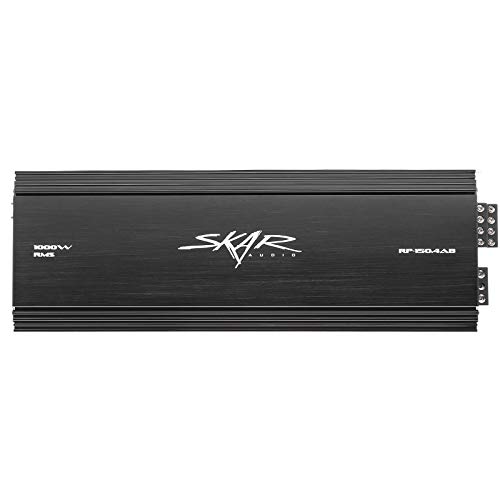
High-Output Speaker Driver – Skar Audio RP-150.4AB
The Skar Audio RP-150.4AB is a full-range Class A/B choice for shoppers comparing four channel car amplifiers with substantial speaker-driving capacity. It is rated at 250W RMS x 4 channels at 2 ohms and 125W RMS x 4 channels at 4 ohms.
Best For: Higher-powered full-range speaker systems using a 4-gauge power and ground connection.
Pros:
- Provides 250W RMS x 4 at 2 ohms or 125W RMS x 4 at 4 ohms.
- Uses a MOSFET Class A/B design.
- Includes four-way protection circuitry.
- Lists a 105dB signal-to-noise ratio and 20Hz–20kHz frequency response.
Cons:
- The supplied dimensions indicate a relatively large 24.5 x 7.5 x 4-inch chassis.
- Its 4-gauge power and ground terminals may require appropriately sized installation hardware.
- The notes do not list high-level inputs or built-in crossover controls.
Select this model when high RMS output and full-range Class A/B operation are priorities, and your vehicle has room for its larger chassis and suitable power wiring.
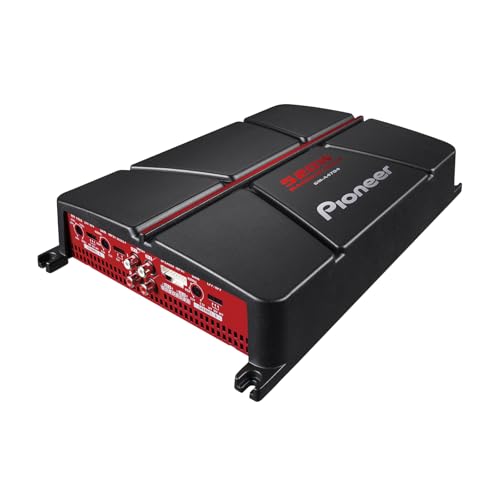
Balanced Upgrade – Pioneer GM-A4704
Pioneer GM-A4704 520W Max Class AB Bridgeable 4-Channel Car Amplifier | Variable High-Pass Filter
Check Price On AmazonThe Pioneer GM-A4704 is a practical choice among four channel car amplifiers for upgrading front and rear speakers while retaining the flexibility to bridge channels for added bass. Its Class A/B design, variable filters, and moderate power output suit everyday systems that prioritize controlled, clean sound.
Best For: Drivers building a balanced four-speaker system with optional bridged subwoofer support.
Pros:
- Delivers 40 watts RMS x 4 at 4 ohms or 130 watts RMS x 2 when bridged.
- Variable high-pass and low-pass filters help tailor the frequency range.
- Class A/B design aims to balance performance, efficiency, and heat management.
Cons:
- Its 520-watt maximum rating is less powerful than the higher-output alternatives.
- Class A/B operation may be less compact and efficient than a Class D design.
The GM-A4704 is a sensible middle-ground amplifier for listeners who want flexible channel configuration and straightforward tone control without moving to an especially powerful system.
High-Power Choice – Taramps TS 1200×4
The Taramps TS 1200×4 stands out among four channel car amplifiers for demanding systems that need substantial output in a compact Class D design. It supports RCA and high-level inputs, making it suitable for both aftermarket and factory-radio installations.
Best For: High-output speaker, subwoofer, tweeter, or component-system builds requiring flexible input options.
Pros:
- Produces 4 x 300 watts RMS at 2 ohms or 2 x 600 watts RMS bridged at 4 ohms.
- High-level inputs with automatic turn-on support factory stereos.
- RCA and high-level inputs plus high-pass, low-pass, and full-range modes provide tuning flexibility.
Cons:
- Professional installation is recommended.
- Its high power level may be excessive for a basic factory-speaker upgrade.
Choose the TS 1200×4 when output and system flexibility matter most. Its strong bridged and multichannel ratings make it better suited to ambitious builds than modest stock-audio replacements.
Budget-Friendly Starter – BOSS Audio Systems R1004
The BOSS Audio Systems R1004 is a straightforward option among four channel car amplifiers for powering multiple speakers on a budget. Its Class A/B topology, full-range capability, and compatibility with 2- to 8-ohm loads allow it to support basic speaker upgrades and some subwoofer configurations.
Best For: Cost-conscious installations needing simple four-channel amplification for speakers and modest bass support.
Pros:
- Rated at 50 watts maximum x 4 at 4 ohms and 100 watts maximum x 4 at 2 ohms.
- Full-range operation can support speakers and a subwoofer when the system is properly matched.
- Compact 7.75 x 9 x 2-inch design and a six-year parts-and-labor warranty offer practical value.
Cons:
- The supplied notes list maximum power rather than RMS output.
- It offers less output than the Taramps TS 1200×4.
- Class A/B operation may be less efficient than a Class D amplifier.
The R1004 makes the most sense for a basic, carefully matched system where affordability and simple full-range operation are more important than extreme power or advanced input flexibility.
How We Picked the Best Four Channel Car Amplifiers
We focused on models that can power multiple full-range speakers or support a more flexible front-and-rear system. The comparison considers advertised RMS output where available, minimum speaker impedance, amplifier class, bridgeability, input options, crossover functionality, and installation practicality. Because maximum wattage figures can be measured under different conditions, RMS output and impedance compatibility are more useful for matching an amplifier to speakers.
The selection includes compact Class D models for efficient installations, Class AB designs that prioritize familiar full-range operation, and higher-output amplifiers for systems using speakers with greater power handling. Always verify the manufacturer’s specifications and fuse requirements before installation.
Quick Comparison
| What to compare | Best use | Why it matters |
|---|---|---|
| RMS power per channel | Matching speakers | Helps prevent underpowering or overpowering the system |
| Class D or Class AB | Efficiency and installation preferences | Class D generally runs cooler and uses less space; Class AB may suit traditional full-range systems |
| 2-ohm compatibility | Lower-impedance speaker loads | Determines whether the amplifier can safely deliver its rated output |
| Bridgeable channels | Adding a stronger pair of channels or subwoofer | Provides more configuration flexibility, when supported |
| Inputs and crossover controls | Factory-radio integration and tuning | Influences installation ease and system adjustment |
Key Buying Factors for Four-Channel Car Amplifiers
Match RMS Power and Impedance
Choose an amplifier whose RMS output fits the speakers’ continuous power rating at the same impedance. A four-channel amp rated for 2-ohm loads can offer more flexibility, but the wiring must remain within the manufacturer’s limits. Do not match components using peak or “max” wattage alone.
Choose the Right Amplifier Class
Class D four-channel car amplifiers are typically compact, efficient, and easier to cool in tight spaces. Class AB models can be a practical choice for full-range speaker systems when space and current draw are less restrictive. Neither class automatically guarantees better sound; system matching and installation quality matter more.
Check Controls and Signal Compatibility
Look for adjustable gain, high- and low-pass filters, and suitable RCA or speaker-level inputs. High-level inputs can simplify integration with a factory radio, while variable crossover controls provide more control over speaker blending and protection.
Plan the Installation
Confirm the amplifier’s dimensions, fuse rating, power and ground cable requirements, ventilation needs, and available mounting location. A high-output model may require upgraded electrical wiring or charging-system support. Professional installation is advisable when bridging channels or modifying factory wiring.
Who Should Buy Which Four Channel Car Amplifiers?
Choose a compact Class D model if you need efficient power in a small vehicle or want lower heat output. A Class AB amplifier is a sensible fit for a straightforward front-and-rear full-range upgrade. Higher-output models make more sense for speakers with substantial power handling and an electrical system prepared for the added demand.
If you are replacing a factory amplifier, prioritize signal-input compatibility and installation dimensions. If you are building a system from separate components, compare RMS ratings, crossover ranges, and bridging options first. The best choice is the amplifier that matches your speakers, vehicle wiring, and listening goals—not necessarily the one with the largest advertised wattage.