Small-scale projects demand more control than a handheld drill can usually provide. The best drill presses for model making offer steadier alignment, adjustable speed, and a compact footprint for workshops, craft rooms, and benches.
This roundup compares 10 selected options across rotary-tool stands, precision mini presses, and higher-powered benchtop designs, helping you match capacity and control to your materials and techniques.
Best 10 Drill Presses for Model Making Picks for 2026
Best Adjustable Stand
Dremel 220-01 Rotary Tool Workstation

- Adjustable drilling angles in 15-degree increments
- Depth stop supports repeatable holes up to 2 inches
- Fits several Dremel rotary tool models
Best For: Portable, Dremel-based model-making work
Best for Precision Layouts
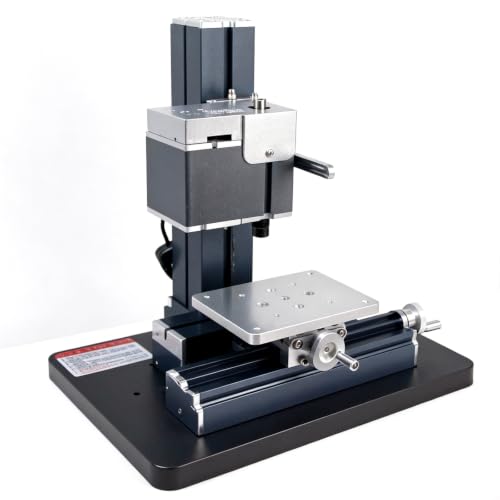
- X-Y table reduces repeated re-clamping
- 0.02 mm handwheel graduations support fine settings
- 20,000 RPM motor with 1–6 mm chuck
Best For: Small parts and accurately spaced model holes
Best Versatile Bench Option
710W Mini Electric Drill Press

- 710W motor for wood, plastic, and light metal
- Six speeds from 0–2800 RPM
- 1.5–13 mm chuck accepts standard bits
Best For: General-purpose DIY model and workshop drilling
Best for Illuminated Craft Work

- Work light aids scale and depth visibility
- Seven speeds reach up to 3000 RPM
- Included vise clamps 1–55 mm workpieces
Best For: Small craft models and light-duty materials
High-Speed Crafting Pick

- 340W motor with three speed levels up to 16,000 RPM
- Compact steel-and-cast-iron design for small workspaces
- Handles wood, plastic, and thin metal projects
Best For: DIY models, jewelry, and detailed craft drilling
Precision Mini Pick

- Adjustable 24V power with speeds up to 7,000 RPM
- Supports 0.6- to 6mm bits and a 40mm stroke
- Includes a mini vise and 10-piece HSS bit set
Best For: Small models, jewelry, toys, and repair work
Depth-Control Pick
Upgrade Mini Benchtop Drill Press
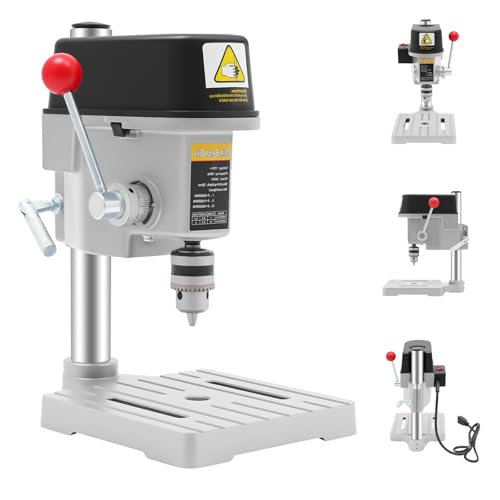
- Marked depth dial provides adjustment up to 0.98 inches
- Three speed settings reach 16,000 RPM
- Sturdy base and 1-10mm clamping range
Best For: Model makers prioritizing controlled depth and speed
Compact Precision Pick

- 400–4,500 RPM variable speed
- 4 mm wood and 3 mm metal capacity
- Stable, compact aluminum-alloy build
Best For: Small model-making and DIY drilling in light materials
Accessory-Rich Workshop Pick

- Includes flex shaft, slide table, and 11 HSS bits
- Three-axis stability and 40 mm stroke
- Supports drilling, polishing, and grinding
Best For: Versatile model-making and jewelry work
High-Speed Capacity Pick

- Three speed ranges up to 12,000 RPM
- 10 mm chuck and 340-watt motor
- Cast-iron base for stable bench work
Best For: Larger model-making holes in wood and other light materials
Best Adjustable Stand – Dremel 220-01 Rotary Tool Workstation
If you already own a compatible Dremel rotary tool, this workstation stand offers a compact way to create straighter, more repeatable holes for drill presses for model making. Its depth stop, measurement markings, and adjustable drilling angles suit detailed hobby work.
Best For: Model makers who want a portable stand for a compatible Dremel rotary tool and small, controlled drilling tasks.
Pros:
- Drills perpendicular or angled holes in 15-degree increments, up to 90 degrees horizontally.
- Depth stop and markings support consistent drilling up to 2 inches deep.
- Metal base has four clamping points for added stability.
- Compatible with several Dremel models and includes cord storage clips.
Cons:
- Requires a compatible Dremel rotary tool; it is a stand rather than a complete drill press.
- Its 2-inch depth capacity limits larger workpieces.
This is a practical choice for model-making benches where portability and angle adjustment matter more than high power or a full-size table. It is especially appealing for users already invested in the Dremel ecosystem.
Best for Precision Layouts – X-Y Mini Drill Press
For model makers who need accurately spaced holes, this compact machine stands out among drill presses for model making because its X-Y table lets you reposition the workpiece without repeated clamping. The fine handwheel controls are suited to detailed layouts in small parts.
Best For: Precision model, PCB, acrylic, plastic, and soft-metal drilling where controlled positioning is a priority.
Pros:
- X-axis travel is 145 mm, with 40 mm Y and Z travel and a 120 × 100 mm table.
- X, Y, and Z handwheels use 0.02 mm scale graduations for fine adjustments.
- 20,000 RPM motor and 1–6 mm chuck support small-diameter drilling.
- All-metal construction and dovetail slides are designed to reduce vibration-related play.
Cons:
- The 1–6 mm chuck range is intended for micro drilling rather than larger bits.
- The 36W motor is aimed at small work in soft materials and light metals.
With dedicated X-Y-Z positioning and both swing-arm and handwheel feed, this is the most layout-focused option in the group. Secure it to a stable bench, as recommended, for the best results.
Best Versatile Bench Option – 710W Mini Electric Drill Press
This compact benchtop machine offers a broader chuck range and more motor power than micro-focused models, making it a flexible option among drill presses for model making. Six speeds help adapt drilling to wood, plastic, and light metal work.
Best For: DIY model makers who want one small bench machine for wood, plastic, and metal drilling.
Pros:
- 710W motor provides substantial power for a compact DIY drill press.
- Six-speed control covers 0–2800 RPM for different materials and thicknesses.
- 1.5–13 mm chuck accepts a wide range of standard drill bits.
- Heavy-duty metal base is designed for stable, accurate drilling.
Cons:
- Listed capacity is 30 mm in wood and 8 mm in metal, so it is not intended for heavy metal drilling.
- Its larger chuck range may be more than needed for very small precision components.
This model makes sense when versatility is more important than ultra-fine positioning. Its adjustable speed and 13 mm maximum chuck provide room to handle general workshop and model-making tasks.
Best for Illuminated Craft Work – Mini Benchtop Drill Press
This small benchtop drill press is tailored to craft materials and light-duty model work. Its work light, locking depth ring, adjustable height, and included vise make it a convenient option for drill presses for model making involving basswood, balsa, resin, plastic, PCB, and thin soft metals.
Best For: Craft and model-making projects using small bits and non-rigid materials or thin aluminum and copper.
Pros:
- Work light helps illuminate the scale and drilling area.
- Locking depth ring and a 5 cm scaled stroke column support batch drilling.
- Seven-speed regulation reaches up to 3000 RPM.
- Included vise clamps regularly and irregularly shaped materials from 1–55 mm.
Cons:
- B10 chuck accepts only 1–6 mm bits, limiting larger-hole work.
- Its 3.5 cm drilling stroke is suited to small projects.
- For metal, the supplied guidance recommends cooling with oil or water and making multiple passes when needed.
The rear-mounted motor and belt guard keep the working area clear, while the light and vise add convenience for detailed bench projects. It is best viewed as a compact craft machine rather than a heavy-duty press.
High-Speed Crafting Pick – Portable Jewelry Drill Press
For model makers who need a compact tool with plenty of speed, this portable drill press combines a 340W motor with three settings from 0 to 16,000 RPM. Its small footprint and cast-iron-and-steel construction make it suited to detailed work on wood, plastic, jewelry, and thin metal.
Best For: DIY model building, jewelry projects, and small craft work requiring variable speed.
Pros:
- Three speed levels reaching up to 16,000 RPM
- 0.04- to 0.39-inch collet range supports varied drill bits
- Compact 6.69-by-6.69-inch footprint with sturdy steel and cast-iron construction
- Supports drilling depths up to 0.98 inches
Cons:
- Drill bits are not included
- Metal drilling capacity is limited to 0.24 inches
- Warranty is listed as three months
This is a practical option among drill presses for model making when portability, high spindle speed, and a small bench footprint matter more than heavy-duty capacity.
Precision Mini Pick – B10 Upgraded Mini Drill Press
This B10 mini drill press is designed for precise, low-noise bench work in a home workshop. With a 40mm drilling stroke, adjustable 24V power supply, and compatibility with 0.6- to 6mm bits, it is a focused choice for small models, resin, wood, plastic, aluminum, and repair projects.
Best For: Small-scale model making, jewelry work, toy projects, and watch or phone repairs.
Pros:
- Solid metal structure with linear bearings to help reduce vibration
- Adjustable speed up to 7,000 RPM
- Includes a mini vise and 10-piece HSS twist bit set
- Base slots allow expansion with a vise or CNC sliding table
Cons:
- Chuck accepts bits only from 0.6 to 6mm
- Designed for wood, plastic, resin, aluminum, and other soft materials rather than heavy-duty drilling
- Maximum drilling stroke is 40mm
Its included accessories and compact 5.9-by-4.7-inch footprint make this one of the more complete drill presses for model making, especially when working with small parts and fine materials.
Depth-Control Pick – Upgrade Mini Benchtop Drill Press
For model makers who want straightforward depth control, this 110V mini benchtop drill press uses a marked handle dial to set drilling depth from 0 to 0.98 inches. Its 340W motor, three speed settings, and sturdy support column provide a compact setup for wood, plastic, jewelry, and thin-metal DIY work.
Best For: Benchtop model making where controlled depth and adjustable spindle speed are priorities.
Pros:
- Marked dial helps adjust drilling depth up to 0.98 inches
- Three settings cover 8,000, 11,000, and 16,000 RPM
- 0.04- to 0.39-inch clamping range accommodates 1-10mm bits
- Thickened base and support column are designed for stable operation
Cons:
- Drill bits are not included
- Metal drilling capacity is limited to 0.24 inches
- The listed dimensions are relatively large for a mini tool
This model is a sensible pick among drill presses for model making when repeatable depth settings and simple roller speed control are more important than a broad accessory package.
Compact Precision Pick – Mini Drill Press
For light-duty drill presses for model making, this compact benchtop machine emphasizes stability and fine control. Its variable-speed range of 400 to 4,500 RPM suits small holes in wood, plastic, resin, aluminum, and other non-hard materials.
Best For: Model makers and DIY users drilling small holes in wood, plastics, resin, and soft metal.
Pros:
- Compact aluminum-alloy body with a thickened, non-skid base
- Variable speed from 400 to 4,500 RPM
- Supports drilling up to 4 mm in wood and 3 mm in metal
- CNC-processed components and a 360-degree rotating JT0 chuck
Cons:
- Limited to small drilling capacities
- Best suited to non-hard materials and soft metal
- Requires a recommended 12V/5A power supply
This is a practical choice when workspace, low vibration, and small-hole accuracy matter more than heavy-duty capacity. Its 30-watt motor and compact footprint are better matched to miniature projects than demanding metalwork.
Accessory-Rich Workshop Pick – Upgraded Mini Drill Press
This accessory-rich option stands out among drill presses for model making when versatility is important. Along with vertical drilling, it supports polishing and grinding with the included flex-shaft setup, while its variable-speed motor reaches up to 7,000 RPM according to the product description.
Best For: Model makers who want one compact machine for drilling, polishing, grinding, jewelry work, and small craft projects.
Pros:
- Includes a flex-shaft attachment, slide table, power supply, and 11 HSS bits
- Solid metal frame with three-axis stability, linear bearings, and dual springs
- 40 mm maximum drilling stroke and up to 6 mm stated capacity
- Base slots accommodate a mini vise or CNC sliding table
Cons:
- Accessory setup may be more involved than a basic drill press
- Its small 6 mm chuck limits bit size
- Speed specifications vary between the listed maximum of 7,000 RPM and detail listing of 8,000 RPM
With its included accessories and modular base, this machine offers more ways to work than a basic benchtop press. It is especially appealing for small, detailed projects where drilling is only one part of the workflow.
High-Speed Capacity Pick – Three-Speed Mini Drill Press
For model makers who need broader speed adjustment and a larger chuck, this compact drill press offers three selectable ranges and a cast-iron base. It is designed for wood, plastic, resin, aluminum, composite board, and other non-rigid materials, with vertical and angled drilling applications noted in the title.
Best For: Users who want a more powerful, three-speed benchtop press for larger model-making holes and light materials.
Pros:
- Three adjustable speed ranges from 1,800 to 12,000 RPM
- 10 mm maximum chuck size
- 340-watt copper-wire motor and cast-iron base
- Compact desktop design with stated capacities of 0.63 inches in wood and 0.24 inches in metal
Cons:
- Intended mainly for non-rigid materials and light metal work
- Larger and heavier than the smallest mini presses
- Product details list a maximum speed of 16,000 RPM, while the bullet description specifies ranges up to 12,000 RPM
This is the strongest capacity-oriented choice in the group, combining a larger chuck with a higher-power motor and multiple speed ranges. Its compact format still saves bench space, though it is better suited to substantial desktop projects than ultra-fine miniature drilling.
How We Picked These Drill Presses for Model Making
We focused on the features that matter most for miniature construction and detailed bench work: spindle control, speed adjustment, chuck range, table stability, footprint, motor power, and practical usability. The selection includes lightweight rotary-tool workstations, compact 36W precision presses, and more powerful 340W- to 710W-class machines for users who also work with metal, wood, jewelry, or tougher materials.
Because specifications and included accessories can vary by seller, verify the current listing for voltage, chuck capacity, depth travel, table dimensions, and warranty information before ordering.
Quick Comparison
A rotary-tool stand such as the Dremel 220-01 is usually the most accessible option when you already own a compatible Dremel tool and need guided drilling without buying a complete press. Dedicated mini presses provide a more integrated setup, with their own motor, column, table, and feed mechanism. Models with X-Y tables are particularly useful when hole placement must be repeated or adjusted precisely.
Higher-powered portable presses are better suited to mixed materials and longer sessions, but they may produce more vibration or occupy more bench space than a compact precision model. Work lights, rear-mounted motors, included accessories, and adjustable speed can improve convenience, though they should not replace a rigid frame and accurate spindle alignment.
Key Buying Factors for Drill Presses for Model Making
Precision and Stability
Look for a rigid column, secure base, low runout, and a table that remains square to the spindle. A stable press is more valuable than headline RPM when drilling tiny holes or delicate parts.
Speed Control and Motor Power
High speed can suit plastics, softwood, and small bits, while slower settings are generally preferable for larger bits and many metals. Variable speed gives you flexibility, but check whether the motor maintains consistent performance under load.
Chuck Range and Depth Capacity
Confirm that the chuck accepts the bit sizes you use most often. For model making, fine-bit compatibility and controlled quill travel may matter more than maximum drilling depth.
Table and Positioning Features
An X-Y positioning table helps with repeatable hole placement and layout work. A work light can improve visibility, while a larger table benefits fixtures and irregular parts.
Safety and Workspace Fit
Choose a machine that fits your bench with room for the workpiece and handwheel. Clamp small parts securely, wear eye protection, keep loose clothing away from rotating components, and follow the manufacturer’s bit and material limits.
Who Should Buy Which Drill Presses for Model Making?
Choose the Dremel workstation if you already own a compatible rotary tool and want the simplest, most compact upgrade. Select a precision mini press with an X-Y table if accurate positioning and small-part control are your priorities. A basic mini benchtop press is a sensible middle ground for general craft drilling, while a 340W or 710W model makes more sense for users who regularly switch between wood, plastic, metal, and jewelry projects.
For occasional hobby use, prioritize stability, ease of setup, and included accessories over maximum power. For frequent production or demanding materials, spend more attention on rigidity, speed control, chuck quality, and service support than on advertised RPM alone.